Building Money Confidence in Kids
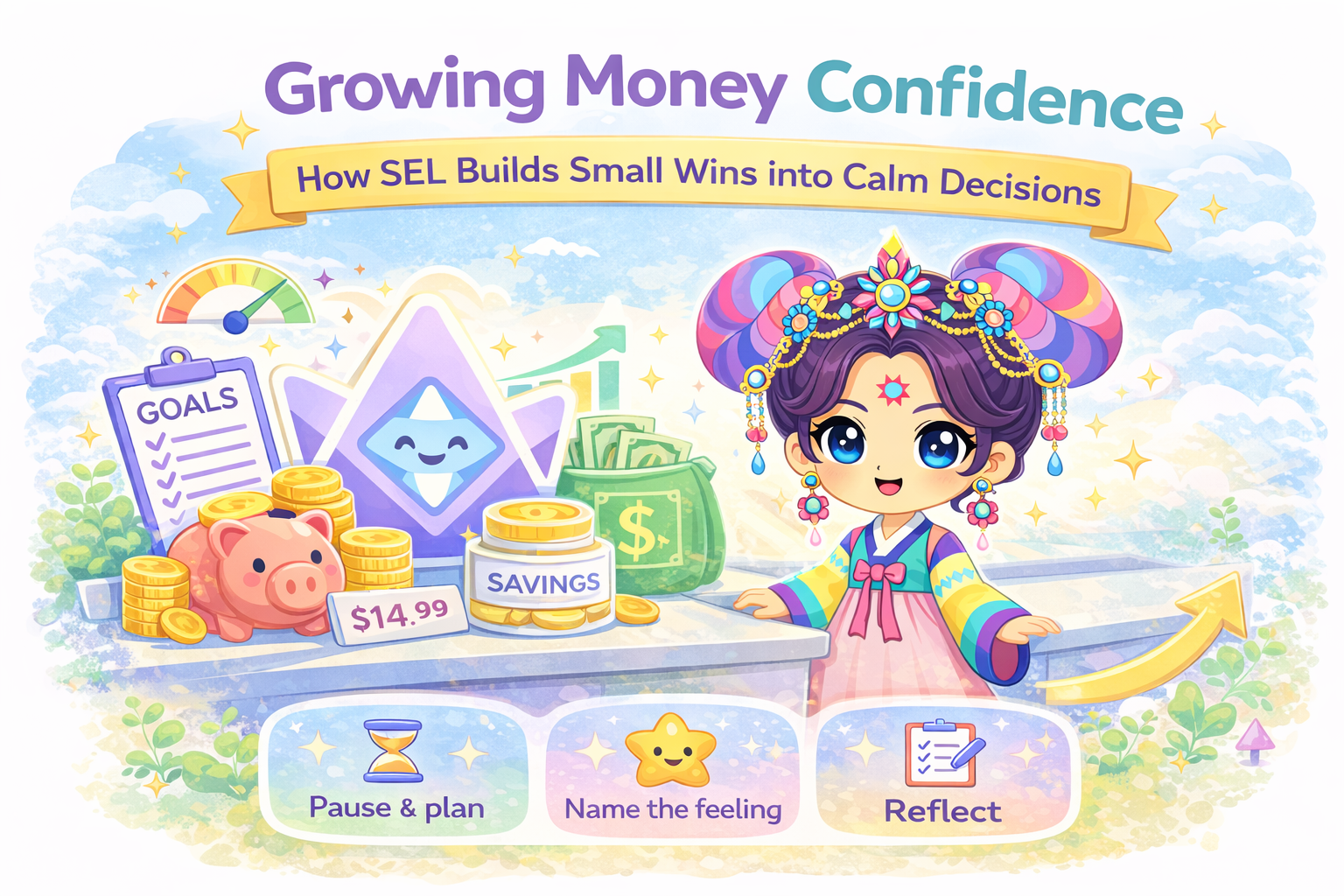
Confidence Building
Money confidence for kids isn't about raising mini-accountants. Rather, it's that calm, capable "I've got this" feeling when a money choice shows up. In K–5, confidence grows fastest when we pair simple money skills with social-emotional learning (SEL): naming feelings, practicing self-control, celebrating small wins. This guide shows families and schools how to build money confidence step by step using positive reinforcement, daily teachable moments.
Overview
"Confidence building" in a money context means helping kids believe they can learn money skills, bounce back after mistakes, and make age-appropriate choices without panic or shame. For elementary learners, money confidence is closely tied to SEL abilities like self-management, growth mindset, and problem-solving—skills that strong SEL programs measurably improve. A landmark CASEL-aligned meta-analysis of 213 school-based SEL programs (270,000+ students) found broad benefits across social-emotional skills and academics, including an average 11-percentile-point gain in achievement, with effects lasting well beyond the intervention window. Those same SEL "building blocks" (self-control, planning, reflection) are also the foundation of financial capability, according to the Consumer Financial Protection Bureau's (CFPB) youth financial capability model.
Why does that matter for K–5? Because kids learn money through lived experiences: saving for something they want, deciding between two options, or feeling disappointed when they can't buy something today. When we teach money skills without the emotional skills, kids often default to avoidance ("I'm bad at money"), impulsivity ("I need it now"), or anxiety ("Money is scary"). When we teach both together, kids practice: pause, label the feeling, choose a strategy, and reflect on the outcome.
Throughout this guide, you'll see progressive skill development (small wins → quests → autonomy), two-way consistency between home and school, and kid-friendly practice through stories and conversations.
What Money Confidence Really Means (and what it doesn't)
Money confidence for kids is best understood as financial self-efficacy: the belief that "my actions can lead to good money outcomes." Research on financial self-efficacy has linked confidence to healthier money behaviors, and it's often strengthened through repeated, supported practice rather than one-time lessons. That's good news for K–5: you don't need a big, formal "finance unit" to start. You need many small, well-scaffolded experiences.
Let's name what money confidence is not:
Knowing all the "right" answers about money vocabulary
Never feeling disappointed when you can't buy something
Being naturally "good with money" (a fixed trait)
Instead, money confidence looks like:
Comfort with choices: "I can decide between two options and explain why."
Emotional regulation: "I can calm down if I don't get what I want today."
Persistence: "I can try saving again if I spent my money too fast last time."
Help-seeking: "I can ask a trusted adult for clarification."
Two real-world examples:
Family example (Age 6): Emma gets $2 a week and wants a $10 craft kit. The first week she spends everything on stickers and feels upset. Instead of saying "See? You can't save," her parent normalizes the emotion: "It's hard to wait." Then they co-create a plan: put $1 into a "craft kit" jar and $1 into "fun now." Emma's confidence grows because the system lets her succeed immediately while still working toward a goal.
Classroom example (Grade 2): A teacher uses a simple "classroom economy" where students earn tokens for teamwork and can spend or save them. A student who tends to spend instantly is given a two-choice script at the "store": "Do you want a small item today, or save for the big one?" After two weeks, the student starts saying, "I'm saving," without adult prompting—an early sign of self-management transferring to money behavior.
A research anchor: CFPB's model emphasizes that executive function (planning, self-control, flexible thinking) is a core driver of youth financial capability—often more predictive than memorizing facts. That's SEL territory.
Why SEL + Money Skills Work Better Together
SEL and money skills reinforce each other because real financial decisions are rarely purely logical—especially for kids. They're emotional, social, and identity-based: wanting what a friend has, feeling left out, seeking control, or coping with stress. SEL gives kids tools for those moments.
Large-scale evidence supports SEL as a lever for confidence-related outcomes. A more recent meta-analysis spanning 90 studies in the United States found SEL improves skills, attitudes, behavior, and school climate—including stronger perceptions of safety and belonging. Safety and belonging matter here: kids practice money choices more willingly when they don't fear embarrassment.
Now connect that to financial development. CFPB's "building blocks" framework argues that early financial capability grows from habits and norms, executive function, and financial knowledge—in that order developmentally. In other words, the youngest learners benefit most from practicing routines (save/spend/share), self-control (pause before purchasing), and reflection ("How did that choice feel?") before we push complex concepts.
Two real-world examples:
Home example (Age 7, grocery store): A child begs for candy at checkout. A parent uses an SEL-based "pause plan": breathe once, name the feeling ("You're excited and you really want it"), then offer a regulated choice ("We can take a picture for your wish list, or you can use your own money if you've saved enough"). The child experiences autonomy without chaos.
School example (Kindergarten): During storytime, a counselor reads a book about sharing and fairness, then introduces a simple classroom "budget" of pretend coins for center time choices (art corner "costs" 2 coins; blocks "costs" 1). Kids practice planning, turn-taking, and coping with disappointment when they can't choose the most expensive center every day.
Step 1: Start with Small, Concrete Wins (Age 5+)
The fastest way to build confidence is to help kids succeed early—on purpose. In SEL research, competence grows when kids experience mastery in manageable steps, especially with explicit practice and feedback. CASEL's evidence base emphasizes "SAFE" practices—Sequenced, Active, Focused, Explicit—to make skill-building stick. We can apply the same approach to money.
Start at age 5+ with tasks that are:
Concrete: count coins, match prices, sort needs vs wants
Short: 2–5 minutes
Repeatable: the same routine weekly
Visible: progress shown in jars, charts, or in-game trackers
Two real-world examples:
"Three Jars" micro-win (Home, Age 5–6): Use three labeled containers: Save, Spend, Share. The win is not the dollar amount—it's correctly placing money and explaining why. The child earns a "confidence badge" (sticker or a simple note) for doing the routine without reminders.
"Price detective" win (Classroom, Grade 1): During a math block, students get picture cards of items and "coin cards." Their job: find one combination of coins that matches a price (e.g., 10 cents). This is an academic tie-in and a confidence builder because kids can show multiple solutions and feel capable even if they choose a different combination than a peer.
To keep it SEL-aligned, pair each win with a feeling check:
"What did you feel when you figured it out?"
"What did you do when it got tricky?"
"What will you try next time?"
Why this works: small wins build self-efficacy through mastery experiences—one of the strongest drivers of confidence over time (analysis consistent with self-efficacy theory; the financial self-efficacy literature also emphasizes repeated successes).
SEL interventions show measurable improvements not only in academics but also in self-related skills like self-management and self-esteem, which are closely related to "I can do hard things" confidence.
Step 2: Use Positive Reinforcement & Daily Quests (without bribing)
Positive reinforcement builds confidence when it rewards effort, strategy, and follow-through—not just outcomes. That distinction matters in money learning because kids can't always control the outcome (they may not have enough money yet), but they can control the process (saving, planning, waiting, asking questions).
Think in "daily quests": tiny missions kids can complete independently. Small, teachable moments reduce overwhelm and create a predictable success loop: try → get feedback → improve. Repeated interventions are especially important in financial education.
Two real-world examples:
Home daily quest (Age 7): "Today's quest: Find one way to save 25 cents." The child chooses: turn off a light, skip a small purchase, or put change in the jar. Parent response focuses on strategy: "You noticed an option and followed through. That's self-control."
School daily quest (Grade 3): "Team Budget Quest": groups receive pretend money to plan a class party snack list with constraints (must include one healthy option; stay under budget). Teacher praises collaboration and emotion skills: "I saw you compromise when you disagreed—that's responsible decision-making."
Inside a safe, ad-free world designed for kids, Satta delivers daily Quests as short, story-driven missions that build money confidence through action. A child might be invited to save toward a meaningful goal, guide a character through a thoughtful spending choice, or care for a virtual pet by choosing how to spend the gems they learn in the game. Each Quest rewards patience, reflection, and persistence—not just speed.
Satta works best when grown-ups echo the language offline. After a Quest, adults can ask:
“What was your strategy?”
“How did you decide?”
“What did you do when you felt impatient?”
The app creates the practice. Adults deepen the learning.
A COPPA-minded note for families and administrators: for kids under 13, choose digital tools that minimize data collection, avoid behavioral advertising, and provide clear parental/administrator controls. The FTC's COPPA Rule requires verifiable parental consent in many cases when personal information is collected from kids under 13, and schools must be thoughtful when they consent on parents' behalf for educational use (general COPPA best practice; select products that clearly state child-directed safety compliance).
Step 3: Gradually Increase Autonomy & Real-World Practice (the confidence bridge)
Once kids have small wins and playful practice, confidence grows through autonomy with guardrails. CFPB's youth financial capability model emphasizes that executive function and habits develop over time and are strengthened when kids can practice real decisions appropriate to their age. The goal is not perfection but progressive independence.
A simple autonomy progression for K–5:
Guided choice: adult offers two acceptable options
Shared planning: child helps set a goal and steps
Independent action: child carries out the plan
Reflection: child evaluates feelings and outcomes
Two real-world examples:
Allowance with a "preview" (Home, Ages 7–10): Before allowance day, a parent and child do a 2-minute preview: "What's your plan for saving/spending/sharing?" The child chooses. If they overspend, the adult avoids shame and uses reflection: "What did you notice in your body when you wanted it? What could you try next time?"
Classroom micro-budget (Grade 4–5): Students receive a small monthly "project budget" of pretend funds to allocate across classroom needs (supplies, reading corner, kindness project). The teacher sets constraints (must reserve 10% for class community) and rotates student leadership. Students practice negotiation, fairness, and delayed gratification—SEL in action.
A data point to motivate long-term thinking: OECD's PISA 2022 financial literacy report notes that a substantial share of students do not reach basic proficiency and that lower proficiency is associated with weaker saving-related behaviors and higher vulnerability to poor financial decisions. While PISA assesses older students, it underscores why early confidence-building matters: by the time financial choices get complex, kids need strong habits and self-belief already in place.
Digital tools can help scale autonomy practice: quests that gradually shift from "choose between two options" to "plan a goal over multiple days." If you use an app, look for features that support reflection (What was your goal? What happened?) rather than just points. In Satta World, this can look like goal-setting arcs and short debrief prompts after each quest—especially effective when paired with a weekly parent/teacher conversation.
Closing the Confidence Loop
Money confidence grows through repetition, reflection, and real ownership. When kids experience small wins, practice daily quests, engage in creative play and gradually take on real-world responsibility, they begin to internalize a powerful belief: I can handle this. The goal isn’t perfect money decisions—it’s tough choices, calm decision-making, resilience after mistakes, and the courage to try again. When families, schools, and tools like Satta World use consistent language and intentional practice, confidence stops being a lesson and becomes a habit.
References:
Cipriano, Christina, Cheyeon Ha, Miranda Wood, Kaveri Sehgal, Eliya Ahmad, and Michael McCarthy. “A Systematic Review and Meta-Analysis of the Effects of Universal School-Based SEL Programs in the United States: Considerations for Marginalized Students.” Social and Emotional Learning: Research, Practice, and Policy 3 (2024). https://doi.org/10.1016/j.sel.2024.100029.
Consumer Financial Protection Bureau. Building Blocks to Help Youth Achieve Financial Capability: A New Model and Recommendations. Washington, DC: Consumer Financial Protection Bureau, 2016. https://files.consumerfinance.gov/f/documents/092016_cfpb_BuildingBlocksReport_ModelAndRecommendations.pdf
Durlak, Joseph A., Roger P. Weissberg, Allison B. Dymnicki, Rebecca D. Taylor, and Kriston B. Schellinger. “The Impact of Enhancing Students’ Social and Emotional Learning: A Meta-Analysis of School-Based Universal Interventions.” Child Development 82, no. 1 (2011): 405–432. https://doi.org/10.1111/j.1467-8624.2010.01564.x.
Federal Trade Commission. “Children’s Online Privacy Protection Rule (‘COPPA’).” Last modified 2023. https://www.ftc.gov/legal-library/browse/rules/childrens-online-privacy-protection-rule-coppa
Hashemzadeh, Kianoosh. “New Study Provides Evidence That Social-Emotional Learning Programs Improve Academic Performance.” USC Rossier School of Education, January 26, 2026. Accessed February 22, 2026. https://rossier.usc.edu/news-insights/news/2026/january/new-study-provides-evidence-social-emotional-learning-programs-improve-academic-performance.
Lee, Jinwoo, and Ji Yoo. “The Effectiveness of Social-Emotional Learning (SEL) Programs on Adolescents’ Mental Well-Being: A Systematic Review.” International Journal of Research Studies in Medical and Health Sciences 9 (2025): 1–6. https://doi.org/10.62557/2456-6373.090101.
Mahoney, Joseph L., Joseph A. Durlak, and Roger P. Weissberg. “An Update on Social and Emotional Learning Outcome Research.” Phi Delta Kappan 100, no. 4 (2018): 18–23. https://doi.org/10.1177/0031721718815668
Organisation for Economic Co-operation and Development (OECD). PISA 2022 Results (Volume IV): Financial Literacy. Paris: OECD Publishing, 2024. https://doi.org/10.1787/pisa-2022-results-vol4-en.
West, Martin R., Larissa Pier, Heather Fricke, Heather Hough, Susanna Loeb, Robert H. Meyer, and Angela B. Rice. “Trends in Student Social-Emotional Learning: Evidence From the First Large-Scale Panel Student Survey.” Educational Evaluation and Policy Analysis 42, no. 2 (2020): 279–303. https://doi.org/10.3102/0162373720912236.