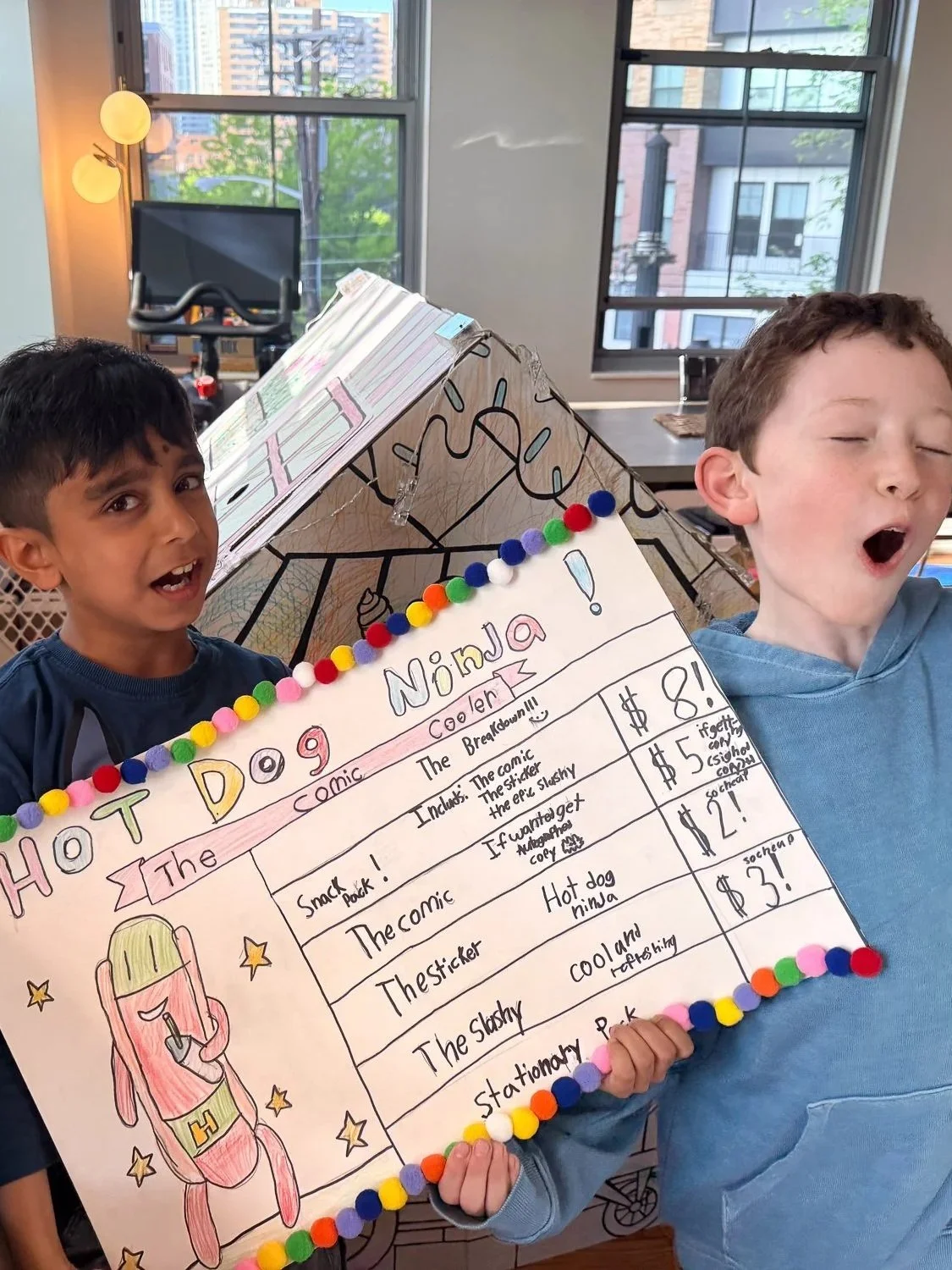
Satta Market kid-founders show off their homemade signs for their business.
Why Satta Market works
TL;DR: Kids learn about money and business best when they do it for real, close to home, on a project they care about, using what their family already knows. Satta Market is built around all four. Research shows that hands-on business programs for elementary-age kids build real confidence: kids get better at taking initiative, trying new ideas and believing they can figure things out [1].
What is a Satta Market?
A Satta Market is a real market day where kids run their own small businesses.
Before market day: using the free Satta World app, kids and their grown-ups dream up a business together. They decide what to make or sell, who it’s for, and what to charge.
On market day: kids set up a table at their school or in their community and sell to real customers: neighbors, classmates, family and friends.
After market day: kids look back at what worked, what surprised them, and what they’d try next time.
Satta market is a real, hands-on experience with real people, real choices and real money.
Why it works
1. Kids learn by doing at Satta Market
Kids make a plan, try it with real customers, think about what happened and try again, with their grown-ups by their side. Research on how kids build lifelong money skills points to this kind of hands-on practice, with parents and kids learning together during the elementary years [2].
A large study of a similar program found that kids grew in confidence, creativity and initiative, and that these skills seem to grow best when kids start young [1].
2. Satta Market happens in their own community
Their customers are neighbors, teachers and family friends, so ideas like “what’s something worth?” become real, face-to-face lessons. Learning means more when it’s tied to the places kids live in [3].
The market belongs to the community, so kids see themselves as people who help shape the place they live. It empowers them as builders, helpers, and founders in their world [3].
3. It’s a hands-on project that they build themselves
From the first idea to market day, kids build one thing they can see, hold and be proud of. Research that pulls together many studies across communities worldwise shows that learning through real projects helps kids learn more [4].
The app guides them step by step, so their excitement manifests into hands-on learning in an actual place in their community.
4. Every family’s knowledge counts - Satta Market draws from family values and culture
Kids build businesses out of what their family already knows and loves, like a recipe, a craft or a something that is passed down. Research shows that every family carries valuable generational knowledge, and kids do better when learning experiences connect to it [5].
Kids don’t have to leave who they are at the door to succeed. Learning works best when kids can grow new skills and take pride in their culture and community at the same time [6].
Bring a Satta Market to your community
Your kids, your school, and your neighbors. An experience that can change how kids feel about money and building something of their own.
Here’s how to start:
Talk to your school, PTA or community group about hosting a Satta Market.
Download the free Satta World app and let your child start dreaming up their business.
Reach out to us at sattaworld.co and we’ll help you plan your community’s market day.
References
[1] L. R. Huber, R. Sloof, and M. van Praag, “The effect of early entrepreneurship education: Evidence from a field experiment,” European Economic Review, vol. 72, pp. 76–97, Nov. 2014, doi: 10.1016/j.euroecorev.2014.09.002.
[2] A. I. Drever, E. Odders-White, C. W. Kalish, N. M. Else-Quest, E. M. Hoagland, and E. N. Nelms, “Foundations of financial well-being: Insights into the role of executive function, financial socialization, and experience-based learning in childhood and youth,” Journal of Consumer Affairs, vol. 49, no. 1, pp. 13–38, Mar. 2015, doi: 10.1111/joca.12068.
[3] D. A. Gruenewald, “The best of both worlds: A critical pedagogy of place,” Educational Researcher, vol. 32, no. 4, pp. 3–12, May 2003, doi: 10.3102/0013189X032004003.
[4] C.-H. Chen and Y.-C. Yang, “Revisiting the effects of project-based learning on students’ academic achievement: A meta-analysis investigating moderators,” Educational Research Review, vol. 26, pp. 71–81, Feb. 2019, doi: 10.1016/j.edurev.2018.11.001.
[5] L. C. Moll, C. Amanti, D. Neff, and N. González, “Funds of knowledge for teaching: Using a qualitative approach to connect homes and classrooms,” Theory Into Practice, vol. 31, no. 2, pp. 132–141, 1992, doi: 10.1080/00405849209543534.
[6] G. Ladson-Billings, “Toward a theory of culturally relevant pedagogy,” American Educational Research Journal, vol. 32, no. 3, pp. 465–491, 1995, doi: 10.3102/00028312032003465.